How to Remember What You Read: Proven Study Methods
Stop rereading and start retrieving. Here is how to use cognitive science to make sure the books you read actually stay in your long-term memory.

You finish a chapter, close the book, and realize you can barely summarize the main argument. This is the common experience of passive reading. Your eyes track the words, but your brain creates no lasting hook to store the information. If you want to remember what you read, you must stop reading for recognition and start reading for retrieval.
The Illusion of Fluency#
When you reread a paragraph, it feels familiar. Your brain recognizes the structure and the vocabulary, which tricks you into thinking you have mastered the material. Cognitive psychologists call this the Illusion of Fluency. Because the text is right in front of you, your brain does not have to work to reconstruct the meaning. Rereading creates a temporary sense of comfort, but it does not build durable memory traces. To break this cycle, you need to engage in Retrieval Practice—the act of recalling information from memory rather than looking at it again.
Why Active Recall Works#
Every time you force yourself to remember a concept, you strengthen the neural pathway associated with that information. This is known as the Testing Effect. Instead of highlighting a sentence, pause after a page. Close the book and explain the concept out loud. If you cannot explain it simply, you do not understand it well enough yet. This struggle is exactly where learning happens. CogniPage automates this by prompting you to retrieve key concepts throughout your day, ensuring your brain constantly revisits important ideas before you have the chance to forget them.
Manage Forgetting with Spaced Repetition#
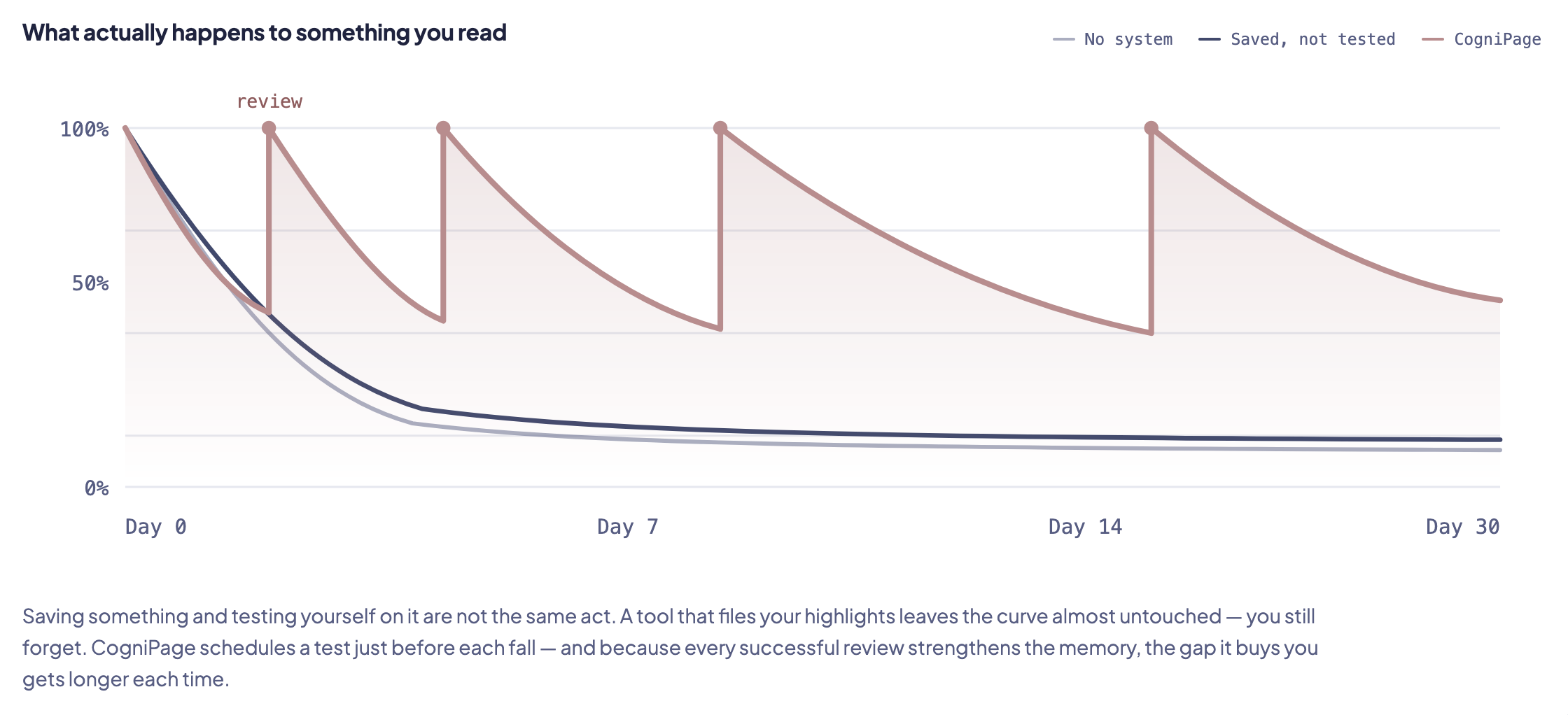
Human memory follows a predictable curve. Hermann Ebbinghaus discovered that we forget the majority of new information within 24 hours unless we review it at specific intervals. This is the Forgetting Curve. To counter this, use Spaced Repetition.
| Timing | Action |
|---|---|
| Immediate | Summarize the core concept in your own words. |
| 24 Hours | Review your summary and see if it still makes sense. |
| 1 Week | Test yourself on the material without looking at your notes. |
| 1 Month | Revisit the concept to move it to long-term storage. |
Elaboration: Connecting New Ideas to Old Ones#
Memory is associative. You remember things better when you anchor them to facts you already know. This process is called Elaboration. When you encounter a new idea, ask yourself:
- How does this relate to something I learned last week?
- Why would an author reach this specific conclusion?
- Can I think of a real-world example that proves this theory?
By building these mental bridges, you stop treating information as isolated facts and start building a connected web of knowledge. This is how you move from being a collector of information to a person who truly understands their subject matter.
Managing Cognitive Load#
It is tempting to try and absorb an entire textbook chapter in one sitting. However, your brain has a finite capacity for processing new information at any given moment, a concept psychologists call Cognitive Load. When you try to force too many complex ideas into your working memory simultaneously, you hit a bottleneck. The quality of your retention drops significantly.
To combat this, embrace Interleaving. Instead of studying one subject for four hours, mix your topics or chapters. When you shift your focus, your brain is forced to reload the context of each subject, which reinforces your mental grip on the material. It feels more difficult in the moment than block-studying, but that added effort is precisely what makes your memory more resilient.
Turn Your Reading Into a Feedback Loop#
Learning is not a one-time event; it is a cycle of intake, testing, and refinement. If you identify a gap in your knowledge, do not simply highlight the text again. Return to the source material, re-examine the core concept, and attempt to explain it in a new way. You can treat your notes as a living draft that grows more accurate the more you interact with it.
By treating your reading as a series of small, active experiments, you transform from a passive consumer of text into a deliberate architect of your own knowledge. Mastery is not found in how many pages you get through in an afternoon, but in how many of those ideas remain available to you a month from now.
Start Small and Build Momentum#
You do not need to overhaul your entire reading routine in a single afternoon. Start by applying these principles to a single book or course. When you sit down to read, set a timer for twenty minutes and commit to just two active recall sessions during that period. The goal is to lower the barrier to entry so you can maintain these habits over the long term.
Remember that failure to recall a fact is not a sign of poor intellect; it is a signal that your brain is actively working to reorganize that information. Embrace the frustration of a forgotten concept. That difficulty is the most reliable indicator that you are finally beginning to learn.
Consistency is ultimately more important than intensity. By integrating these practices into your daily reading, you replace the fleeting thrill of 'finishing' a chapter with the quiet, permanent progress of internalizing what you read. You are no longer racing to reach the end of the book. You are building a foundation that stays with you long after the cover is closed.