
Why Do You Keep Forgetting What You Study?
Have you ever spent hours reading, highlighting, and taking notes, only to find yourself struggling to recall the information a few days later? It's a common and frustrating experience for learners…
Have you ever spent hours reading, highlighting, and taking notes, only to find yourself struggling to recall the information a few days later? It's a common and frustrating experience for learners. You put in the effort, but the knowledge just doesn't seem to stick.
You're not alone. The human brain is designed to forget. Understanding why you forget is the first step toward building more effective study habits and making your learning last.
The Forgetting Curve: A Natural Process#
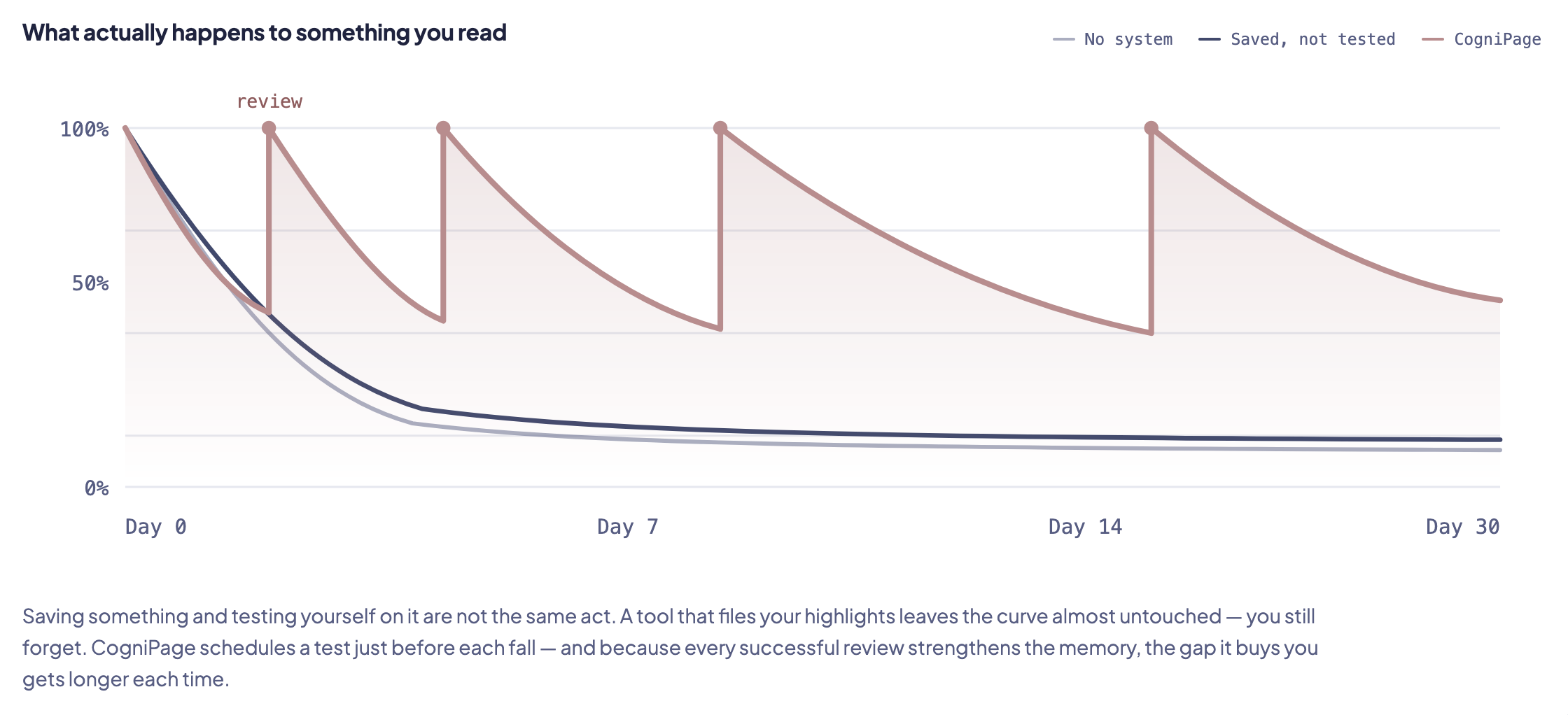
One of the most foundational insights into memory comes from Hermann Ebbinghaus, who, over a century ago, described what we now call the forgetting curve. His research showed that you forget new information very rapidly after first learning it, with the steepest drop occurring shortly after initial exposure. If you don't actively work to retain it, a significant portion of what you study will vanish from your memory surprisingly quickly.
This isn't a sign that you're a bad learner. It's how our brains prioritize information. If something isn't revisited or actively used, your brain assumes it's not important and clears space for new incoming data. Think of it like your computer's RAM: temporary storage that needs to be moved to permanent storage, or it's lost.
Passive Reading Leads to Shallow Processing#
Many students fall into the trap of passive study. This often looks like:
- Rereading chapters multiple times.
- Highlighting almost every sentence.
- Copying notes verbatim from a textbook or lecture slides.
While these activities feel productive, they often lead to shallow processing. Your eyes pass over the words, and you might even recognise the information if you see it again. But recognising something is very different from being able to recall it from scratch. Recognising means the information is presented to you; recalling means retrieving it from your own mind without prompts. If you just reread the chapter three times, you will recognise it, not recall it. This feeling of familiarity can fool you into thinking you know the material better than you actually do, a phenomenon known as the fluency illusion.
To combat this, you need to engage with the material more deeply. Don't just look at the words; think about them.
Skipping Retrieval Practice Means Skipping Learning#
Perhaps the most powerful technique for building lasting memory is retrieval practice, also known as the testing effect. This means actively trying to recall information from memory. When you quiz yourself, explain a concept out loud, or try to solve a problem without looking at your notes, you are engaging in retrieval practice.
Each time you successfully retrieve a piece of information, you strengthen the neural pathways associated with that memory, making it easier to recall in the future. Even struggling to recall something, and then finding the answer, is beneficial. It highlights gaps in your knowledge and tells your brain what information needs more attention. Conversely, if you never try to retrieve information, those memory traces remain weak and fade quickly.
Think about it: an exam is a retrieval practice session. If your study method never includes retrieval practice, then the exam is the first time you're truly testing your recall under pressure. That's a recipe for forgetting.
Neglecting Spaced Repetition Wastes Effort#
Connected to the forgetting curve is the idea of spaced repetition. Cramming all your study into one long session might get you through a test tomorrow, but it's incredibly inefficient for long-term retention. This is because of the spacing effect.
Instead of one long study session, distributing your learning over several shorter sessions, with increasing intervals between them, makes memory much more durable. Each time you revisit the material after a short break, you are re-encoding it, solidifying the memory trace just as it's about to weaken significantly according to the forgetting curve. This is far more effective than trying to jam it all in at once, which often results in interference and shallow encoding.
| Study Method | How it Feels | Memory Effectiveness |
|---|---|---|
| Cramming | High-pressure and exhausting | Results in shallow encoding and rapid forgetting. |
| Spaced Repetition | Gradual and consistent | Creates stronger neural pathways and long-term retention. |
Spaced repetition aligns with how your brain best consolidates information, helping it transition from short-term to long-term memory more effectively.
Failing to Elaborate on New Information#
Your memory is like a vast web of interconnected ideas. New information sticks best when you can link it to what you already know. This process is called elaboration.
When you simply memorize facts in isolation, they have nowhere to 'anchor' themselves. But when you ask questions like:
- How does this relate to something I already understand?
- Can I explain this in my own words?
- What's an example of this concept in the real world?
- How does this connect to other topics in this subject?
You are elaborating. You are building richer, more meaningful connections, creating multiple pathways to retrieve the information later. The more connections you make, the stronger and more accessible the memory becomes. For instance, instead of just memorizing *"photosynthesis uses sunlight, water, and carbon dioxide to produce glucose and oxygen"*, try to visualize a plant in your garden, absorbing sun, taking in water from the soil, and breathing in CO2. Imagine the process happening inside its leaves, creating food for itself and releasing the air we breathe. You are connecting the abstract facts to a concrete, visual, and even personal experience.
Overloading Your Working Memory#
Your working memory is like a temporary mental workspace. It's where you hold and manipulate information actively, right now. It has a very limited capacity, typically able to hold only about 4-7 pieces of information at a time. This limitation is known as cognitive load. When you try to take in too much new, complex information at once, you can quickly exceed this capacity.
Imagine trying to juggle too many balls simultaneously. Some will inevitably drop. Similarly, if a lecture or a textbook chapter introduces too many new concepts without sufficient explanation or without connecting them to what you already know, your working memory becomes overwhelmed. New information struggles to be processed and transferred to long-term memory because there's simply no mental space for it.
This isn't about intelligence; it's about how your brain processes information. When you feel confused, lost, or like your brain has just "switched off" during a study session, it's often a sign that you've hit your cognitive load limit. Breaking down complex topics into smaller, manageable chunks and ensuring you understand each step before moving on can significantly reduce this overload.
Turning Forgetting Into Learning#
Understanding why you forget is the key to studying smarter, not just harder. The good news is that each of these reasons for forgetting points directly to a powerful study strategy:
- Combat the Forgetting Curve: Don't wait until the last minute. Use spaced repetition to revisit material at increasing intervals.
- Move Beyond Shallow Processing: Engage actively with the material. Don't just reread; explain, summarize, and question.
- Embrace Retrieval Practice: Test yourself constantly. Flashcards, practice questions, and self-quizzing are your best friends. The effort of recalling strengthens your memory.
- Elaborate and Connect: Link new information to what you already know. Create stories, analogies, and real-world examples. The richer the connections, the stronger the memory.
- Manage Cognitive Load: Break down complex topics. Focus on one idea at a time, and ensure you grasp it before moving on.
By consciously applying these research-backed techniques, you can transform your study habits. You'll move from passively consuming information to actively building robust, lasting memories. This deliberate approach not only helps you retain more but also deepens your understanding, making learning a more rewarding and effective process.
Tools that automate spaced repetition and make retrieval practice easy, like CogniPage, can significantly streamline this process. They ensure you revisit the right information at the right time, turning your notes and reading into powerful memory-building tools without you having to manually track everything."